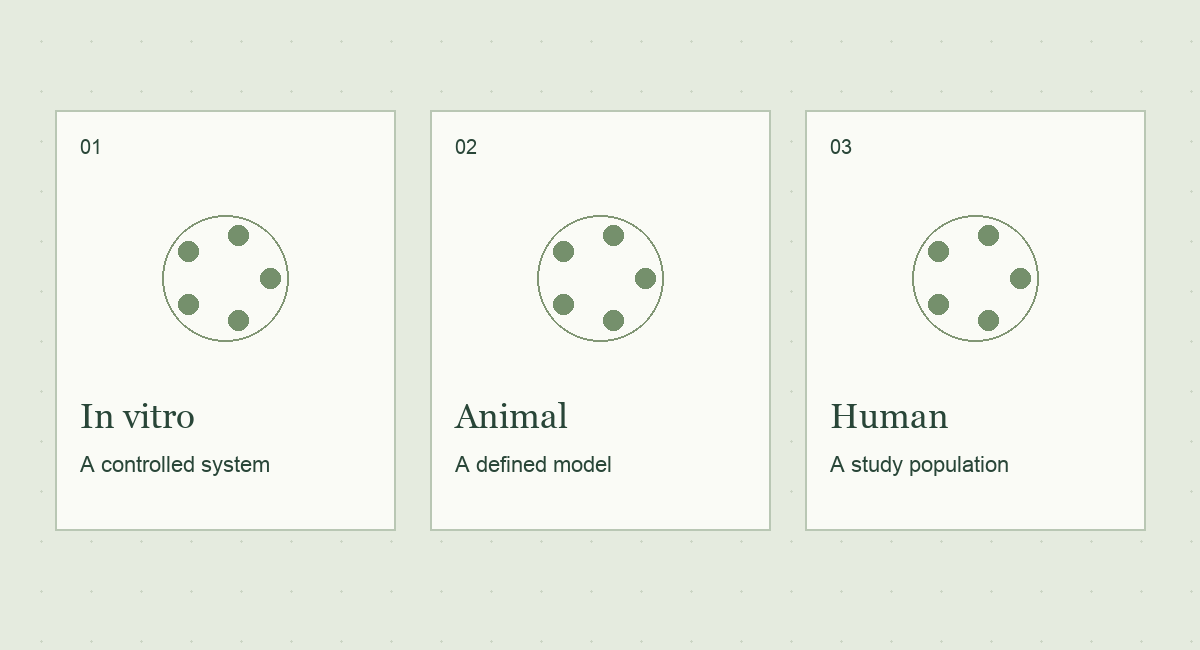
A change of model is a change of evidence—not a small detail.
In vitro: a controlled setting
In vitro research takes place outside a living organism, for example with isolated molecules or cultured cells. It can help researchers investigate a mechanism under defined conditions. A controlled setting allows variables to be separated and measurements to be repeated.
That control also creates a boundary. A cell culture does not reproduce an entire organism. Its environment, exposure conditions and measurement methods need to be described before a finding can be interpreted.
When a summary says “laboratory research showed…”, look for the actual system. A purified-protein assay and a cell-culture experiment are both laboratory work, but they are not interchangeable.
Animal research: a whole organism, a specific model
Animal experiments can explore questions that require a living system. Their interpretation depends on the species, model, characteristics of the animals and study design. “In vivo” means within a living organism; in a preclinical discussion it commonly refers to animal work, but the term itself is broader.
Ask whether the model is suitable for the research question. Reporting guidance such as ARRIVE encourages enough detail to understand the design and analysis. The presence of an animal result does not establish the same result in people.
Do not treat a diagram showing cells, animals and people as a promise that a compound will progress from one stage to the next. Research can stop, change direction or fail to replicate.
Human research: design still matters
Human studies are not one uniform category. Observational work examines relationships without necessarily assigning an intervention. Randomised trials assign participants to comparison groups using a random process. Each design has strengths and limitations.
Read eligibility criteria, outcomes, follow-up and missing-data handling. A human study in one defined setting does not answer every question about a material, every population or every commercially available preparation.
Mechanistic plausibility, an observed association and a well-controlled intervention result are different kinds of information.
A model comparison you can use
| Model | Useful reading question | Common overreach |
|---|---|---|
| In vitro | What system and assay were used? | Treating a cellular response as a human outcome. |
| Animal | Why was this model chosen? | Assuming results transfer unchanged to people. |
| Human | Who was studied, and compared with what? | Generalising beyond the population and material tested. |
The table is a reading guide, not a ranking of every possible study. A strong experiment answers a question its design can actually address.
Write the model into your summary
A useful summary names the setting before the finding. “In this cell model…” or “In the participants included in this trial…” makes the boundary visible. Include the endpoint and the main limitation in the same note.
If a sales page leaves the model out, return to the source paper. Evidence should not become broader as it moves from a study to a headline to a product description.
References & further reading
Background resources for the concepts in this guide. These organisations do not endorse this publication or its affiliated range.