Read the result together with the method that produced it.
Start with the actual question
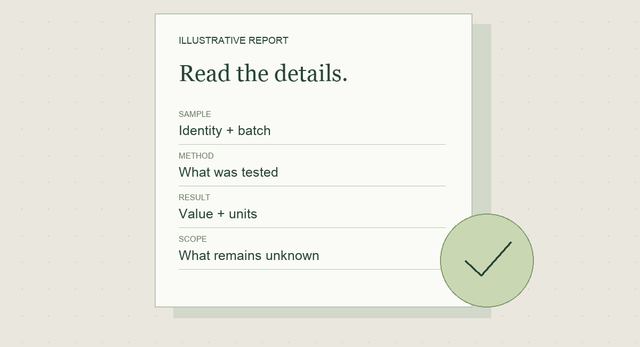
Before interpreting a paper, write down its research question in one sentence. Identify the material, the model, the comparison and the outcome being measured. If any of these are unclear, the headline is already giving you less information than you need.
An abstract is a useful map, but it is not the whole study. Open the methods, figures, supplementary information and limitations. Check whether the authors are testing a defined prediction or exploring a range of possible relationships.
Keep your summary narrower than the paper’s most enthusiastic sentence. For example: “The authors measured a change in this assay under these conditions.” That is more useful than an unqualified claim of effectiveness.
Examine the design before the conclusion
Ask how samples or participants were selected, what the comparison group received and whether the measurement was made consistently across groups. Look for an explanation of sample size, exclusions, randomisation and blinding where relevant.
Reporting frameworks can help you find missing information. ARRIVE addresses reporting of animal experiments; CONSORT addresses randomised trials. Neither checklist is an automatic quality badge. A well-reported weak design can still be weak.
- What is the independent experimental unit?
- Are repeated measurements being confused with independent samples?
- Were outcomes and exclusions specified before results were known?
- Can another reader reconstruct the central comparison?
Read figures with their captions
A graph needs its axes, units, sample information and legend. Check whether the vertical axis begins at zero and whether the plot shows individual observations, an average or a transformed value. These choices influence the visual impression.
A small p-value does not tell you the size or practical relevance of a difference. Look for effect estimates and uncertainty, and ask whether the analysis matches the experimental design. If many comparisons were explored, consider how the authors handled that issue.
Describe one figure without using “works”, “proves” or “breakthrough”. State what changed, how it was measured and what remains uncertain.
Look for the boundaries of the result
Ask what the study did not test. A short observation period cannot answer every long-term question. A narrow sample may not represent a wider population. A laboratory endpoint may not correspond to a meaningful outcome outside the experiment.
Read funding and conflict-of-interest statements. Commercial involvement does not automatically invalidate a study, but it is relevant context. Independent replication and consistent findings across appropriately designed work deserve attention.
Check the journal’s page for corrections or retractions. If you only have an abstract, say so in your notes rather than filling the gaps with assumptions.
Make a five-line study record
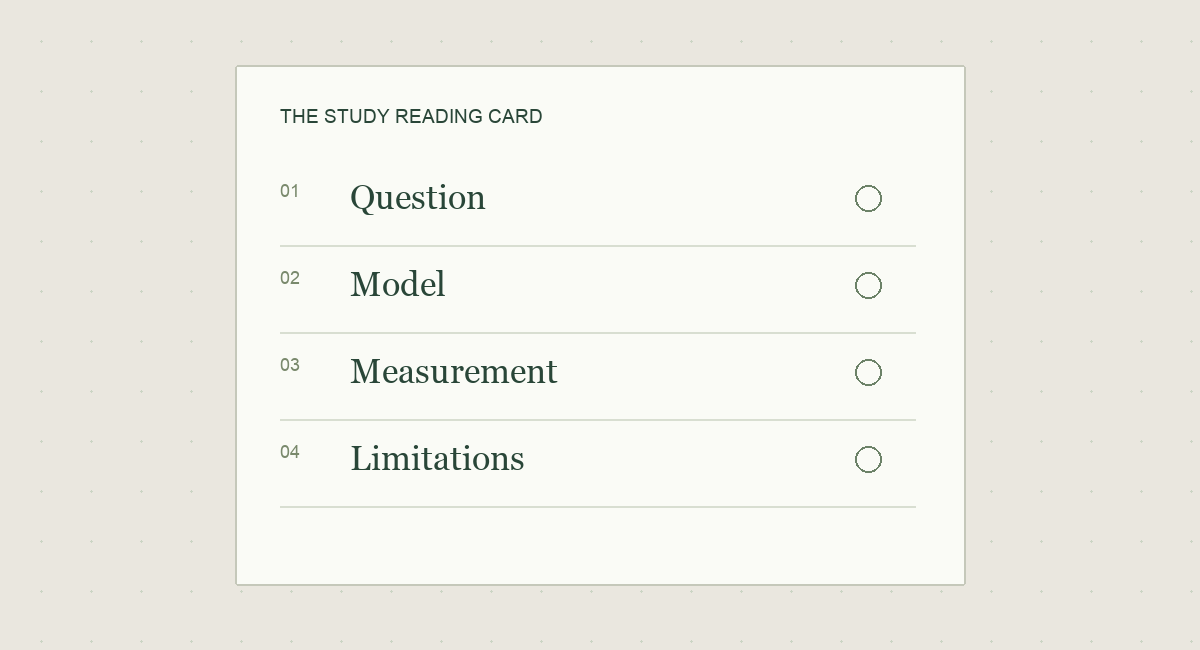
- Question: what was investigated?
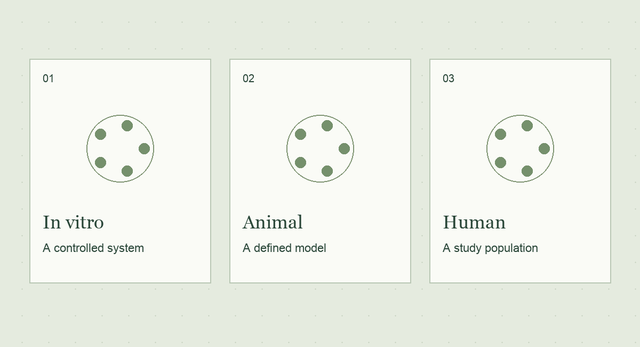
- Model: cells, animals, people or a computational system?
- Comparison: what was the relevant control?
- Finding: what was measured, with what uncertainty?
- Limit: what conclusion would go beyond the data?
This record is an editorial reading aid, not a validated scoring tool or a substitute for specialist statistical assessment. Its value is consistency: it makes your reasoning visible when you compare papers.
References & further reading
Background resources for the concepts in this guide. These organisations do not endorse this publication or its affiliated range.