A COA reports specific tests on a specific sample. Read its scope before its headline number.
Start with the sample, not the percentage
A certificate of analysis, often called a COA, records analytical information about a sample or batch. Before reading the results, identify what was submitted, who tested it and when. Look for the material name, batch or lot identifier and a report identifier.
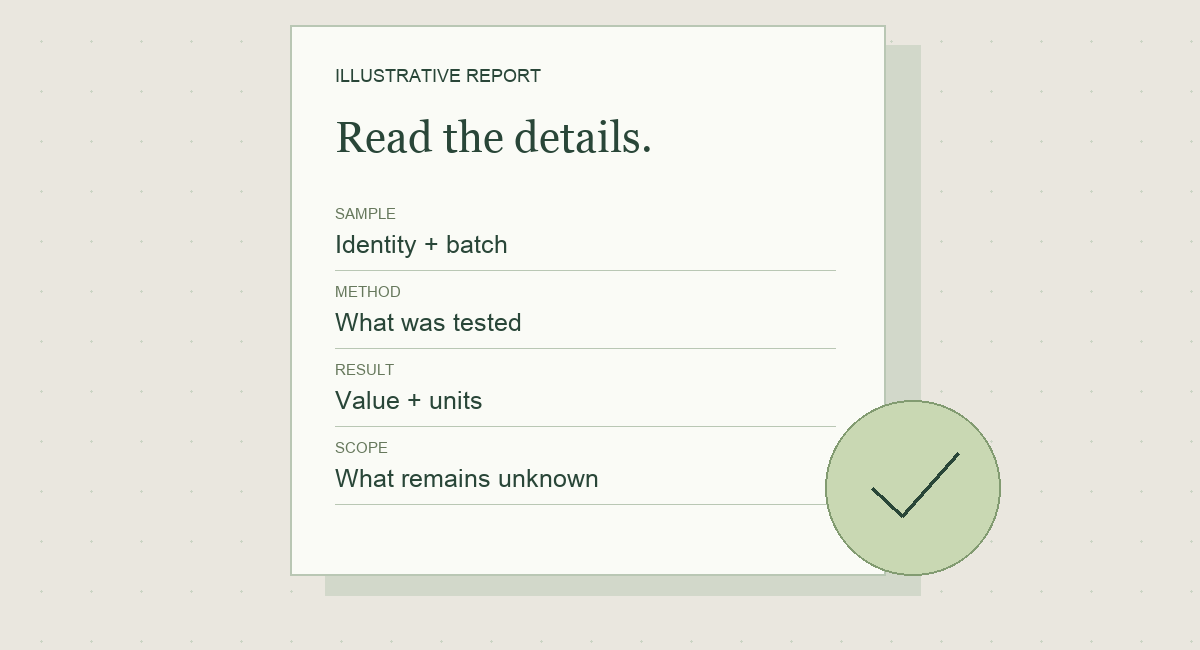
Match those details with the material you are evaluating. A report for another lot may be informative about a supplier’s documentation, but it does not establish the properties of your lot. A cropped image that hides sample details limits what can be checked.
A useful report makes the path from sample to result understandable. If that connection is missing, ask for clarification rather than assuming that a prominent percentage applies to every item in a catalogue.
Check the test and the reported result
Look for the method, result, unit and any acceptance criterion. These are different pieces of information. A specification describes what is required; a result describes what was measured. “Pass” without the underlying context can be difficult to interpret.
Identity and chromatographic purity are also different questions. One asks whether the evidence is consistent with the intended material; the other describes a measurement of sample composition under a particular method.
- Is the method named clearly enough to understand the test?
- Does the result include units or explain its percentage basis?
- Is there a date and an identifiable issuing laboratory?
- Are limitations or omitted tests apparent?
What a COA cannot establish on its own
A report only supports conclusions within its analytical scope. It is not automatically evidence of sterility, absence of every contaminant, clinical safety or suitability for personal use. Those are separate questions requiring relevant evidence.
A purity result is not the same as the amount of peptide in a container. Water, counterions, residual solvents and method-specific detector response can complicate that comparison. Read the stated basis of the result instead of treating every percentage as a mass fraction.
The report graphic on this site is an educational diagram. It is not a product COA, a laboratory endorsement or a record of testing by Study & Method.
Ask questions that can be answered
Request the complete report and ask how its batch identifier relates to the supplied material. If a laboratory’s identity or a document’s authenticity is uncertain, use independently located contact details to ask the laboratory about verification.
Ask which tests were not performed. “Not tested” is a useful answer because it defines the evidence boundary. An attractive report layout, signature image or QR code does not replace checking the underlying information.
For formal laboratory work, the responsible researcher should decide whether the documentation is sufficient for the intended method. Different experiments may require different specifications.
Keep a record with the material
Store the original report alongside the lot identifier, receipt date and relevant laboratory records. Keep revised reports distinguishable from earlier versions. This is a practical way to preserve traceability when a website or product listing changes.
WHO guidance linked below concerns pharmaceutical quality-control laboratories. It is useful background on analytical documentation, not a claim that a research supplier is WHO-certified or that its products meet pharmaceutical requirements.
References & further reading
Background resources for the concepts in this guide. These organisations do not endorse this publication or its affiliated range.