Ask what was measured, how it was measured and what the number actually represents.
HPLC separates a sample over time
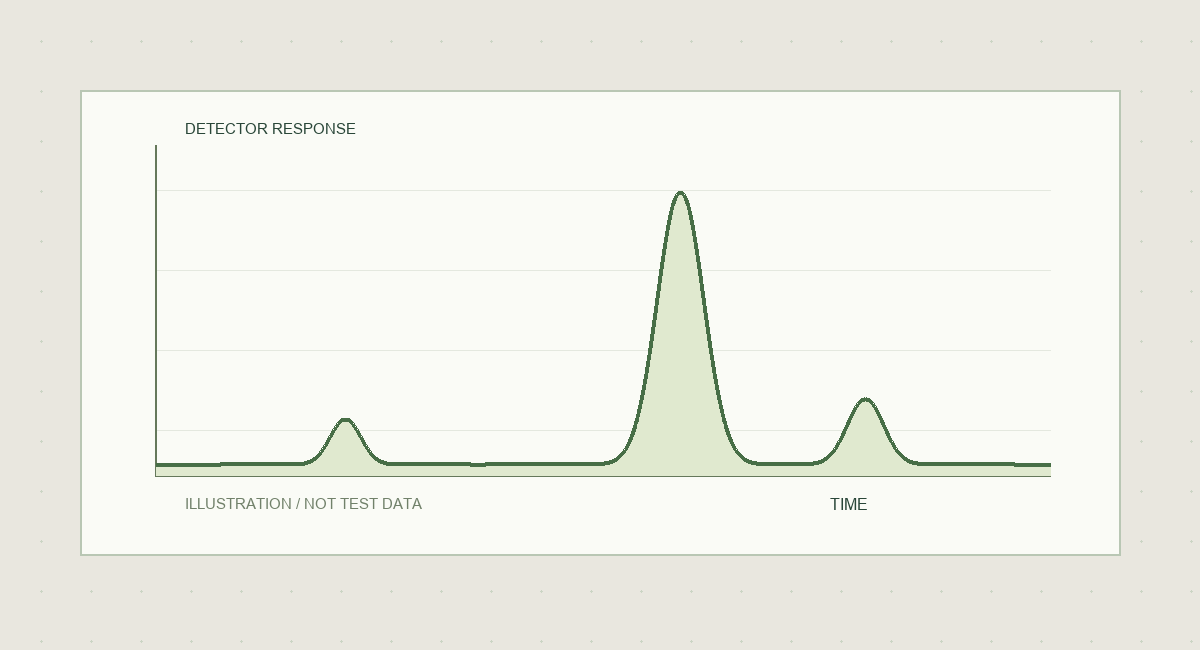
High-performance liquid chromatography, or HPLC, separates components as a sample moves through a column with a liquid mobile phase. A detector records a response over time, producing a chromatogram. Different methods can produce different separations.
A peak is a measured response, not a universal label for a molecule. Interpretation depends on the method and supporting information. Retention time can be useful, but a peak appearing at an expected time is not, by itself, a complete identity assessment.
Our chromatogram illustration is deliberately schematic. It explains the idea of a signal over time and does not represent a tested product, real sample or claimed purity result.
An area percentage has a defined basis
Chromatographic area percentages compare integrated detector responses under the stated method. They should not automatically be read as the percentage of the entire sample’s mass that is peptide.
For meaningful quantitative work, analysts must consider calibration and the measurement system. Ask whether the report describes an area calculation, a calibrated assay or another quantity. The label “purity” can conceal these differences if no method is given.
A single number without the chromatogram, method or calculation basis is harder to assess. That is a reason to request context, not to infer that the material necessarily passes or fails your requirements.
Mass spectrometry adds identity information
Mass spectrometry measures ions according to their mass-to-charge ratio. The observed patterns can support chemical identification. Tandem mass spectrometry adds fragmentation information that may help distinguish candidates.
NIST’s spectral-library work illustrates the importance of reference data and measurement conditions for identification. A mass spectrum is not simply a visual badge saying “verified”: it needs interpretation within the method used.
Chromatography helps separate components. Mass spectrometry provides information about ions. Neither phrase alone tells you every property of a sample.
Separate identity, purity and quantity
- Identity
- Is the analytical evidence consistent with the intended material?
- Purity
- What components are detected, and how is their relative contribution expressed?
- Quantity
- How much of the target material is present, using an appropriate measurement basis?
These questions can require different methods. A report that addresses one should not silently be treated as answering all three. The same principle applies to other properties, such as water content or residual solvents.
Use the result within its limits
When comparing reports, compare methods and definitions before comparing percentages. Two apparently similar numbers may have different meanings. Ask a qualified analyst to resolve an ambiguity that matters to an experiment.
A practical report note might read: “The document reports a chromatographic area result; identity evidence is listed separately; the amount of target material has not been established by this number.” Clear wording is more useful than an unqualified “high quality”.
Analytical information supports research decisions. It does not establish medical safety, benefit or approval for personal use.
References & further reading
Background resources for the concepts in this guide. These organisations do not endorse this publication or its affiliated range.